Saturday, July 23, 2011

The Danger of the Written Word

A week ago today, I embarked on what has turned out to be a very dangerous trip.
Not the wandering amid the streets of Jamestown, but the aftermath of my account of that event.

Instead of our usual cherished Saturday adventures deep in the ‘bend down’ boutiques of Makola, T and I headed to a much advertised arts festival.

The truth is that I have indeed become skeptical of the punctuality and grandiosity of events as advertised - and this comes from being disappointed many times over the past 15 years in Ghana.

The Street Art festival indeed disappointed me as I’d suspected it would. I spent two hours there and I did not give the event a ‘chance’ to get going. I later read some amazing accounts on Graham’s blog and others, and saw some great photos on Nana Kofi Acquah’s Photo blog here.

I was not in the mood that day to revel in the brightness of the eyes of children, to see the hope and beauty they possess inherently. I saw instead the reality of choked gutters and endemic poverty. I ignored the hope that the idea of art and expression brought to the area. I was in a melancholic mood.

But in writing about this, I made some mistakes that have taught me some valuable life lessons.

1. We have a responsibility to write without assumptions. We as bloggers are seen in a way as journalists, and the way we represent an event paints a picture. A picture that might be half drawn. That might not be coloured in for the reader.

2. As a blogger, we must accept that we are viewed, judged and convicted on the words of each post. We are therefore only as good as our last post. I may have written many times about the beauty, the vitality and the amazing spirit of Ghana before, but in one post, my jaded slant created a false impression that it’s very difficult to live with.

3. Readers can feed off the energy of comments. Mass mentality can happen on a website, as quick as can happen in a crowded street where someone shouts ‘thief’! Since writing my account of a less than perfect festival that I witnessed a portion of, in my bad mood, I have been labeled a racist, a bigot, an uninvited, unappreciative monger of poverty writing, and far, far worse.

It is disturbing and hurtful to be at the centre of a witch hunt in a country that I have called home for so long. It is sad to me that one blog post has created a venomous and violent response from the fellow bloggers that I share a creative space with, in Ghana’s online community.

I have learned many things. That I must be careful – I must present more well rounded accounts of events and leave my moods at home. That it is far more uplifting to see the beauty around us than the negative, as it is everywhere and it permeates. It is more of a challenge and more rewarding to pluck out the good and raise it up above the bad.

I have learned that hatred lies so shallow below the surface, and I have seen it’s ugly face in the blog posts and comments hurled at me. I have seen how easy it is for people to judge, to condemn without knowledge. To push someone into a box, a label that doesn’t befit them. (Perhaps I also unwittingly labeled and boxed the community of Jamestown with my account…)

I am resilient though, and I will continue to live my little life, and write from my humble perspective, and if Ghana will not embrace me, I will embrace myself.

The people of Jamestown too are resilient, and will brush off my grumpy critique, as it has been pointed out that I was not the intended audience, and if the children enjoyed the day, that is far more important.

I’d like to close with a quote that all of us should take to heart. It will help in my writing and I hope it will help my scathing critics:

“If each man or woman could understand that every other human life is as full of sorrows, or joys, or base temptations, of heartaches and of remorse as his own . . . how much kinder, how much gentler he would be.”

Monday, July 18, 2011

Chale Wote - festival for the hungry?


For weeks my inbox has been bombarded with event invites, information, flyers and promotional blurbs about an upcoming Street Art festival in Accra. In Jamestown, the poorest, most densely populated ghetto in Accra. Not only was it strange to be getting email correspondence about a festival in Jamestown, but foreign embassies were involved and were even asking for volunteers for the day.

One of the website blurbs states:

The festival is free and open to the public with more than 2,000 patrons expected to attend. CHALE WOTE Street Art Festival is a collaborative effort produced with the help of the Ga Mashie Development Agency, the Foundation for Contemporary Artists, JustGhana, Attukwei Art Foundation, Pidgin Music, DUST Magazine, ACT for Change, The WEB, and Ehalakasa Poetry Slum.

My carefully constructed cynicism told me that the event was a disaster in the making or at best, a non-starter, but I agreed to ‘check it out’ with T, for old times’ sake – to celebrate the curiousity that has helped us to know Ghana so well through the years.

This Saturday was the big day. T and I piled into a rickety taxi, left the relative serenity of Osu, and asked to go to the prison (the main Jamestown fort being both the ‘hub’ of the daily activities, AND the oldest prison in Ghana). He obliged. As he honked and dodged along the bumpy roads, we sat, bright and scrubbed and carefully devoid of jewellery or purses, looking out at the increasing squalor, the tightly choked lanes, the throngs of passers-by, jostling between taxis, tro tros, head loads and knee high festering piles of rubbish. We were in the heart of Jamestown.

He dropped us at a random corner, which seemed just as good as any, and we nodded at the cluster of old men gathered on makeshift benches on the other side of the green swamp gutter. We entered a dirt square, bordered by concrete walls, that housed an unorganised mess of people under canopies, selling fufu and a sad array of ‘local crafts’, along with a brass band in matching yellow t-shirts. There were easily 200 children below the age of 10, stomping around the band, in a rainbow of school uniform colours, following the pied piper of Jamestown, a lanky guy, with red rimmed hipster glasses, a hand painted t-shirt and a wacky expression.

Then the pied piper saw us, motioned to his crew and within seconds they attacked. Hundreds of knee high sets of brown hands and faces, all over our arms and legs, shouting, chanting, laughing, pushing. “Obruni!!!!!!!”

“Oh no!” This was NOT on my agenda. I have no clue why he sent them to us, but just as fast as they’d arrived, he motioned for their retreat and they were off, marching in another direction, leaving us self conscious and confused; the imprint of tiny bare toes on our ankles and feet; in a thick cloud of dust.

We tried to find something interesting to keep us there, but alas, after T taught the seller of the ‘ancient African beads’, that most were in fact, less than 6 months old and from China and India, we wandered out of the square.

We stood forlorn on the street corner, a spectacle of white curiousity, while T consulted her list of activities, printed off from the numerous flyers. There were hopeful events listed there, such as spoken word readings, experimental theater, fashion circus, Brazilian fight dancing, bike and rollerskate stunting party, live music etc. Looking around at the complete lack of signs, vibe and such, and instead at the din of a usual Saturday afternoon in Jamestown, kids bathing naked at the roadside, mothers sweating, pouring the dirty water from the buckets of their lives into the open fetid gutters… I remained skeptical.

Just then, T spotted the sign for a project that the North American Women’s group has been donating funds. It was painted roughly by hand, “Jaynii Streetwise” at the edge of the lighthouse (a colonial legacy at the coast and edge of Jamestown’s grasp). We stood for a minute at the top of the huge stone steps that led downward and out of view. Before us was the beach, a sand the colour of toast, and beyond that the vast ocean, whose waves sounded so peaceful and so at odds with the mayhem of the neighborhood behind us. To our right, knotted masses of fishermen’s nets hung on the broken and decaying walls of what was once a colonial building. Now, the half enclosed crumbled walls were occupied by family upon family. The children ducked and dived between their mothers as the women bent over the weekend laundry buckets. We were essentially within a few feet of the private lives of others, as if looking into an ant colony in primary school science class. No one noticed us though, and we descended the stairs.

We were on the beach. A few concrete rooms at various stages of completion were dotted along to the left. Some were painted, most half built. Nothing at all was happening here. One got the impression that the idea of anything one day occurring here had been abandoned. (I had read online that there was a bar here with the same name two years ago, complete with thatched umbrella shaded tables, but nothing of this is left today).

As we rounded the front of the first building we saw some movement. The door opened and a beautiful woman in a white sleeping dress emerged - turns out she is Jay of Jaynii. Behind her, the dark room produced small faces, one by one peering out at the visitors. I noticed a colouring book and fresh bright crayons on the floor by the door and knew the donations had definitely reached here.

Jay seemed not the least bit surprised by our impromptu visit, and while she explained to T what was ‘going on’ with the project, I peered in further. There were new looking caramel coloured leather sofas, two of them, piled with bags and boxes and ladies and children. They just seemed so odd. So out of place in this little salty, stuffy room at the edge of Jamestown, on the beach.

Jay introduced us to her new baby, sleeping peacefully in a small bassinet. Then she took us on a tour. But there was nothing much to see.

“Here is the hostel for the street children” she explained. It was a shell of a building. Nothing in it. No windows. It will be completed by next week. Hmmmmm.

“50 children will stay here. We need to get them out of what they are living in – urgently.” I wondered what she meant by this. Up above us on the the main street, the children lived in small rooms with no windows. They scrambled for food, they barely made it from day to day. What would be different here in this ghostly set of rooms?

“Here are the washrooms and toilets, donated by NAWA. But we haven’t yet finished the toilets.”

“Where is the library?” T asked.

“It is there.” We did not see it.

“Are there books for the library?”

“Yes there are some books.”

We didn’t see those either.

Jay invited us to her upcoming wedding celebrations as well - and though we were flattered, I had to wonder - weddings in Ghana, as elsewhere are expensive affairs. Jay lived in this one tiny room with at least 12 other people - how would she afford such an event. I hoped she was marrying rich...

Back at the top of the steep steps we bumped into an American couple, kitted out with money belts, sunglasses, festival programs in hand. They looked about as silly as us, and they hadn’t found anything more going on than we had.

Eventually we came across a couple more ‘events’ on random side streets – which consisted of western highschool students (who had obviously volunteered), looking flustered and harassed, policing groups of wild local kids, in painting dead car tires, t-shirts and walls. It was chaotic and not very entertaining, but at least the kids seemed to be having fun or some semblance of it.

We found another group of kids and a few artists in a decaying courtyard as well. Some were painting the walls, and three young Jamestown boys with roller skates on were jumping rows of their brave friends on the floor. A smattering of expats wandered between them all, trying to find enough to stick around for. We couldn’t find enough and ended up at Osekan, a beach front bar just out of Jamestown’s reach.

With our feet up, we sipped cokes. I wondered where the French Ambassador was. Did the funders visit their event? Did the do-gooders hope and expect to create a fully organised festival in the midst of a slum where food and water are luxuries?

What is art when you are hungry? What place do we have in pushing concepts onto people. What if they would have appreciated a bag of rice instead of paint on the streets? Tomorrow’s bath water, tipped into the road, will wash it away, and nothing will be left but a sour memory of another failed project in Ghana.

>>>>>>>>>>>>>>>>>>>

I have removed all photos that I had added to this post, which were not taken at the event, nor did they accurately represent the event. Instead, I tried to borrow some great photos from Ghana blogger Nana Kofi Acquah - who managed to get some great shots. Unfortunately Blogger will not let me upload photos as there seems to be a bug of some sort with this over the past two weeks :( I strongly recommend visiting Nana's site.
Wednesday, July 13, 2011

In the news: Ghana today


Corpses have been removed from Tema morgue today, following an invasion of mice that were eating the bodies. It is not clear whether the hospital or family members are transferring the bodies to various other facilities./// Ghana’s President Atta Mills spoke to the nation on Sunday, giving the assurance that government would institute measures to check the menace of homosexuality and lesbianism that were gaining grounds within the country. He said those acts were contrary to the word of God and the norms and values of the Ghanaian society. He spoke in response to the words of Reverend Bosoma, who warned that if preventive measures were not taken, the situation could result in misfortunes and disasters in the country, just as it happened to Sodom and Gomorrah. The Reverend also condemned improper dressing, especially wearing of short skirts and open-chest blouses by females to expose their breasts, saying the practices were due to wrong adaptation of foreign culture./// Two Pastors of the Conquerors Redemption International Church, and a trader were charged with possessing fake currencies after suitcases of fake GHC50 notes were recovered from the church./// The Environmental Protection Agency (EPA), announced the organisation of a durbar for the Transport Union to highlight health hazards associated with noise making. This has become necessary due to the intensity of noise making by some drivers at lorry stations and within the metropolis./// The Chief Nankpanduri and Naa Nimoh Naabare, the Chief of Kpemale in the Bunkpurugu-Yunyoo District Assembly in the Northern region, have held a joint press conference denying reports that they are at war because of a parcel of land./// Yaw Kesse, a 30-year-old farmer, was on Thursday sentenced to 16 months imprisonment by a Koforidua Magistrate’s Court for stealing cocoyam. When confronted he admitted to having stole the yams and sold them to a woman./// The Presbyterian Church of Ghana has presented a brand new Renault Duster 4x4 vehicle to the Headmaster of the Suhum Presbyterian Senior High School (SHS) to facilitate his work. At the same presentation, Rev. Dr Mante expressed concern about reports of homosexuals and lesbianism invading educational institutions in the country and urged heads of institutions and teachers to be vigilant and monitor the students and bring all those involved in those practices out. The school remains in need of a school bus./// A 45 year old farmer who doubled as a fetish priest, shot himself dead in the Nanumba-North District after butchering to death his third wife who was pregnant. His first and second wives were injured, but escaped death by fleeing. It was revealed during the investigation that the Police have in their possession a single obsolete Tata pick-up meant for patrolling two widespread districts.

Sunday, July 3, 2011

Can Watching TV Be Therapeutic?


We’ve been watching In Treatment. An American TV series shot entirely within the confines of a therapist’s office. (The entire script is adapted from the Israeli show Be Tipul) It’s addictive and engrossing. J has even been glued to it, and he has no suspension of disbelief, meaning he normally hates any fictional drama series.

Throughout my life I’ve had friends in therapy. I felt like it was some sort of club I didn’t really need, had no clue how to join, but had a morbid curiousity about. I wondered whether there could truly be a formula where peoples’ lives could be spoken – like puzzle pieces poured onto a table - and with a therapist’s presence, reflecting the words back upon the wounded one like a mirror, the puzzle would fit together and the person would emerge cured…

In as much as a TV show reflects the reality of our lives, the series illustrates the fact that there is no secret at all. That therapists are not special nor gifted. That they have neuroses of their own, that they can be weak and impulsive and damaged. That they cannot see the patterns they theorize about, when it comes to their own lives. In essence, that they are just one of us. Normal in their imperfections.

This is depressing and elating at once.

At the end of the season 1, the hero, our therapist, decides finally to follow his heart, professing his love for a patient with whom the sexual tension has been palpable throughout the series. He visits her house, enters her bedroom and … has an anxiety attack on the edge of the bed. He begins to sweat uncontrollably and gasp for air. He flees.

I never believed in anxiety attacks when I was younger. I grew up with the impression that most psychological problems were just melodramatic self absorption. This was easy to believe. Easier than facing the possibility that life’s experiences could damage our minds, our hearts, our souls.

One day a few months after my six year old son died inexplicably in my arms, I found myself at the bottom of a pool of air, forgetting how to breath it in, how to stand, how to walk. I was gripped with panic at the thought of walking down the stairs, sipping water, living another moment. In my mind, I knew that something had to give. I would have to pass out or vomit or die.

I had an anxiety attack. I found myself on the side of the road in my car, on the streets of Accra, in a neighborhood I knew well. Lost, out of breath and terrified. I had to call a friend to come and save me.

I knew then that the mind was a delicate organ and I was so scared that mine was tipping into the uncontrollable. Turning against me. I have never been more frightened about my own sanity. I needed a miracle.

I wanted a therapist to soothe my shaking psyche. To talk me through my own mine field of experience. To make me better.

I came to realise that the choice was inside me. The strength to pull up and out of the abyss. Time is a healer, more than a $150 an hour psychotherapist.

Their theories and the incessant talking about memories and feelings are all stabs in the dark to help us, but in the end, futile without us. I have lost the naive belief in external cures. I am much more in awe of the human brain now though, and how it reacts to the blows of reality. I will never venture to judge again...

But my morbid curiousity is not abated. I have realised that watching the therapy dynamic is fascinating in it’s inaccuracy, interplay, and raw emotion. It makes brilliant television.

Friday, June 3, 2011

Ode to an Old Soul : For the Grand Mother who has gone

My grandmother died last night.

Most will send condolences and imagine the cordial service at a local church.

Some will picture her 93 year old frame, frail and dusty, giving in without resistance to the reaper’s grasp.

None will imagine her as the hero, bagging carrots in a factory until each finger bent irrevocably under the burden. Single handedly putting two boys through school on a pittance wage.

None will know how she loved Boy George later, his energy and crazy hair, and kept his poster on the back of her guest bedroom door in her tiny apartment with the slanted walls…

They will sit quietly at her funeral service, hands in their laps, listening to the generic words of the priest - not knowing that she was vibrant and alert, not so long before, and painfully aware of the limitations of her failing parts.

They won’t realise that she kept the family memories alive and well in her mind – she had the sharpest memory I’ve known. S at up in her hospital bed two months ago, head crusted with blood from where she’d fallen, body hunched and dry and so tiny… she said to me matter-of-factly:

“I’m 35 years old in here” (pointed at her heart)

“Getting old is annoying. People talk loudly to me. But I’m the same person I was at 35, just got stuck in this old body”


And it struck me.

So many are afraid of old people. They fear the fragility, as like a mirror, it fortells the future. It forces us to face our own mortality and the sickly smell of urine, warm and without dignity, that characterizes the demise into old age. It repells us.

We see them so often as already gone – mentally, physically. Many will not look for that flicker in their eye, that could reveal a person to relate to and understand. A person who has loved and been loved.

But it struck me when my gramma said this to me. I looked deep into her eyes, and there she was. Lover of shortbread cookies and the best baker of them in the world. A mother, a sister, a soul that I could relate to. It was a reminder that one day, this could be me.

I wanted to reach out to her, to hug her so tightly. But she’s never been the affectionate type. And her body had grown so skeletal (from the bad food, according to her), that I had to resist. To just be content to be in her presence. A woman who I’d grown up with. Who I had always loved, and who in that moment, I was so connected to.

And then I had to fly away, as I do, and the news came of her continued weakness.

The nurses hovering around her, a patient number on their rounds, chatting amongst themselves, lifting body parts and replacing them mechanically.

They didn’t know who she really was. I suppose they didn’t have time to look.

And as the talking around her got louder, she became quieter and more still. Her breathing got more shallow and her body started to shut down.

She slipped into a sleeping state. She was tired. I wasn’t there, but I know she was too tired to carry on. What with the annoying oxygen tube they put across her little face, and the sores on her legs refusing to give her a moment’s peace.

She decided to go, my grandmother did.

And as with everything in her life, she knew her own mind and she did what needed to be done.

But for us weaker ones left behind, I only hope we can do her legacy justice. Her soul escaped our world and left an emptiness we now hold.

Go well Gramma, we will remember you for the wonderful woman you were. No generic lip service from me. I love you forever.

Tuesday, May 31, 2011

Ode to the grown up boy - on leaving for University

I’m pressing my head up against your warm chest, breathing you in for those last ticking seconds.

Your sturdy arms encircle me so briefly but so tightly. There is action around us, the lights of cars and cameras, swirl around. The car horns are a dull – only barely piercing my consciousness. The suitcases and carts and people are all petty distractions, the reality around us is nothing. I am flooded with the emotion that is everything. That is my entire heart, my soul - all escape in a hot mess of tears, and my last futile attempts to hold my baby close.

Just minutes ago, we were singing along to the songs that you brought into my life, that will forever connect us through time. No One is Ever Gonna Love You More than I Do… I sang so loudly. I sang those words like an anthem. Like a Band of Horses, they were my ode to you.


We didn’t speak on that last drive through the city, on the way to this moment at the airport, where you have grown up in an instant and now you are gone.

I close my eyes and breathe you in; you, the tiny warm body against mine, just hours after your birth. I am transported for just a second. I am only twenty three. Clueless. A kid myself, but so desperate to be the mom you deserve. I pat the warm smooth fluff of your newborn hair and hold your miracle earlobe in my fingers. I weep.

I am at once elated and terrified. How will I raise you up? What will I give you? What will it take? I am only comforted that the love I have is everything. It encompasses me and it is a shield around you.

And now, as you tower above me, eighteen years have vanished behind us. There is no looking back. You are a man. Have I done the right things? Has the love been enough? Will it shield you now?

You have become so much more than that twenty three year old could imagine. We grew up together, you and me, outside the box. On the edge. Sometimes I held you close to protect you, and at times it was you who held me. Like the middle name I chose for you in those first few days of life, you are, and you have always been ‘Mompati – my companion’. I took you far far away from home. Together we crossed continents and navigated cultures. We have found love and opportunity and profound sadness. We have found joy.

And somewhere in there, you grew up. My quiet, sensitive boy, you became a shining musician and a stellar speaker. You taught yourself the things I couldn’t, and you didn’t hold my weaknesses against me. You see me, the flawed, the fragile... The girl who raised you up with the best of intentions.

And I know today that somehow, the love I had was strong enough. You in turn are stronger. The world awaits you, and it has a great surprise coming.

Please never be afraid to shine or share yourself. You are my gift to the world and I am proud to send you out there. Send you, guitar in tow, with your pile of suitcases, back across the continents, as you head down the footpath at the departures hall. And as you turn to wave goodbye, though my eyes are blurred with tears, I can see that spark, and it calms my worried mother-heart.

Go well Mompati. I love you more than these silly words can say.

Tuesday, May 10, 2011

The Liar, Our Witch and my Wardrobe

Sometimes I am just completely blind sided by Ghana. There are moments when I am busy minding my own business, living my little expat life within the confines of this African republic, and culturally I trip over something that just has me reeling.

And then I remember that despite my hard drives full of pirated American TV series that fill us with the ultimate superficial each weekday evening, and the goat cheese in my salad, made with imported iceberg lettuce; this is NOT North America, and this little capsule called our home is situated squarely within an entirely different world.

There are undercurrents that pulsate just below the surface in Ghana, in my office, in my yard, in the strangers who pass me on the street. And there are moments when they peek out, when that reality faces me. At those times I am never prepared.

Last night I was bopping around my humid kitchen, wearing my Hello Kitty pyjama set, with my freshly washed hair tied up; I was dishing up our supper plates, anxious to head back into the relative cool of the living room to watch some mind numbing TV series.

“Madam” came the low voice from the pool of darkness beyond my kitchen window.
“Eric?” (assuming it was our gardener, (term used very loosely) who lives at the back of the house).

“Madam, I believe you are busy but I need to speak to you. Very important, very urgent. I beg.”

I begrudgingly put down my ladle and agreed to meet Eric around the side of the house.

So we met, I in cartoon pants with brightly coloured kittens scattered about my legs, opening the sliding doors, the bright and cool mixing with the dark heat. Eric stood glumly almost out of sight on the veranda.

“Yes Eric, what is wrong?” – I of course, assuming there would be a long winded story of medical or other woe, and a plea for money. But this was a different problem altogether.

Eric shifted and stuttered and said Madam a few times.

“It’s about Gilbert” (our cook and cleaner who has worked for the company over 12 years).

“Yes Eric?! What about Gilbert?”


“Well Madam, he is disturbing me in ways you won’t understand. In fact, it is very serious.”

“Ok, well you tell me and I’ll see what I can do” (me, clueless)

“Madam, in fact, he has been trying to… trying to… well he has been determined to kill me spiritually”.

Silence.

My first instinct is to laugh, which probably won’t go over well. I can see the shiny sweat on Eric’s forehead, reflecting the light from behind me. He is very serious.

“Madam, maybe these things you cannot understand. But even physically, he has been doing things. I am having so many challenges in life. Josephine has gone (this was Eric’s girlfriend, who was always way out of his league in my opinion), and Gilbert even today, he…. Well I must confess there was a problem in this house today”

Eric went on to explain that Gilbert had called a certain driver and started to talk to him loudly about how Eric had not been pulling his weight around the house, implying he was useless, and ‘damaging’ his name. Eric then came out of his room and they argued. Gilbert is a liar and possibly a witch?!

I was really not sure why the two of them would be arguing, nor what I was expected to do. But mostly I was pinching myself, wondering if really, I had been called out to hear that one of my staff was trying to kill the other spiritually. Juju. Again. This theme keeps reappearing.

And it’s not just among the relatively uneducated. Making that assumption would be to miss the undercurrent and remain completely oblivious to how this society functions.

I got up this morning with last night’s event freshly in my mind. I greeted Gilbert who was busy making eggs and saw Eric through the window. He was wielding a machete, and hacking away at the overgrown weeds. He gave me a look. His eyes narrowed, his brow furrowed. And he nodded. As if we had shared something… as if I should now understand… Yet I just smiled and carried on as the shallow obruni I am.

I arrived at work, thinking I’d left behind the sinister world of magic cooks and revengeful gardeners… and then I saw this.

A respected Member of Parliament in Ghana’s opposition party, on Ghana’s most popular morning television talk show this week, has claimed he has ‘conclusive evidence’ that the current president, John Atta-Mills, used a magic ring to win the election. He apparently wore the ring only during the election campaign – never before and never after. That is the only proof needed apparently. So there it is. Juju. Things I’ll never understand.

Eric left me with one final comment/warning as we parted ways at my sliding door last night.

“Madam- there are other things. When you go away Gilbert brings his own things to wash at your house. He delays in doing your things. And madam, I just want to say, THAT IS THE MAN WHO MAKES YOUR FOOD.”

And he wandered off pensively into the night.

And there I stood. I looked down. Hello Kitty smiled innocently back up at me. And I acknowledged that I who knows nothing, will have to resign myself to that fact.


Above - a table at a fetish market - selling ingredients for magic brews and curses....

Thursday, May 5, 2011

Walking in My Shoes - a trip and a loss.

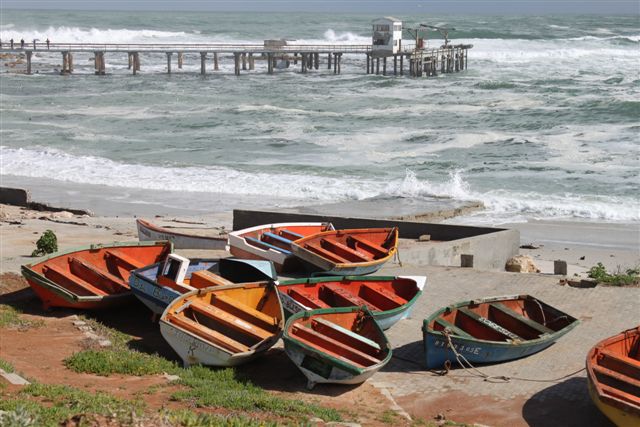
Right now, in a tiny fishing village on South Africa’s arid West Coast called Doringbaai, my favourite shoes are living an entirely new life.

With the affection others reserve for beloved pets, loyal and by your side through thick and thin, I regarded my little black flats. They have literally toured the world with me. I confess that I can’t remember what country I bought them in originally, but I quickly discovered that they were more comfortable than slippers, yet worked in almost any scenario. And being flat and pliable, they packed so well too!

I have always had a difficult relationship with shoes. My wide feet and painful hereditary bunions (what a word), (thanks for that mom), have always meant that I’ve had to respect function before fashion. Most heels are excruciating and dainty shoes with thin straps across the foot are OUT in my world.

Then I found THE SHOES. Made by Nike – but never to be found again, despite searching in every mall ever since – they were crafted from real soft leather, flat, chinese slipper style, with a solid, athletic hidden sole. They were my saviour in so many situations. My comfort on long walks, in shopping malls, on rough trails, on my feet for hours at trade shows, dinners, cocktails, long plane rides across continents, office hours, party hours, market jaunts across Africa. How many shoes can say the same?!

So naturally I took them along (as always) on my latest trip – a meeting in Johannesburg, followed by a tack-on, sanity restoring, leisurely holiday to Cape Town.


We decided once in Cape Town, that having toured most of the Southern Cape, it would be a new adventure to travel northward up the west coast. It was a great trip. Unlike the touristy garden route and numerous wine routes, the west coast is dotted with genuine, hard working fishing villages.

The roads out to the coast from the main highway, branch like spindles on a spiders web, each country road opening up to the raging waves of the Atlantic, with a small settlement at each, clinging to the history of fishing that has been their livelihood and defined them all forever. It was quaint, and sometimes beautiful. It was small wooden brightly painted boats and toothless smiles. It was Afrikaans signposts and tiny galleries, small local restaurants and a persistent mist that blanketed the area each evening by 5.


We walked and walked, we shivered basked in the sun, and investigated all the corners we could. We met some great locals. We ate some fresh calamari. We saw the sets of seasonal campers from local inland towns, come to the coast for their seaside holidays.
My little black flats accompanied us everywhere (there they were below, on one of our last days together).


And then we came to Strandfontein.


The northern most stop on our trip, before the 5 hour journey back down the main highway to Cape Town. It was a sterile little town, built up a sloping hill, populated by a mosaic of modern guest houses and holiday retreats. The beach was long and flat and gorgeous. We knocked on some doors, inquired about accommodation for one night, found a friendly flat manager and booked in to a full little apartment.

We asked of restaurants and discovered there were none. We were told that 5km down the road, in the ‘coloured village’ of Doringbaai, there was a great little seafood place, run by an Afrikaans ‘tannie’ (aunty) and we should head over to book. We took a drive over to have a look. It was a tiny, non-descript village, built on the small fishing industry, and teeming with workers from the next town.


South Africa’s history, as we all know, is uncomfortable to say the least, when it comes to races and race relations. All over the Cape, there are coloured towns and villages. These people are truly a mixed group, each carrying blood from the original Kung San, Afrikaans whites, Malay, Indian, black and others. Despite the fact that the wide mixes mean that everyone looks so different, they are a distinct group with a certain accent, culture and community. They refer to themselves as coloured, so I had to overcome my North American hesitation, given the history of the word on our side of the world!

The fact is, that the coloured communities remain relatively poor, despite apartheid ending close to two decades ago. Laws can change overnight, but societies take a lot longer!

The small, majority coloured community of Doringbaai, are mostly fishermen and many work as domestics in the houses down the road in Strandfontein.

As we arrived for check-in, we met two of them. Both were maids, taking a no doubt well deserved break, after a day of cleaning. We greeted them, put down our things and headed out. The next morning we saw them padding along the road to start work as we left, and waved. Little did I know I’d left a piece of myself behind in that bedroom, that would link us forever. My favourite shoes.

I’m of course assuming here, that anyone would want my old beaten up shoes, as people’s forgotten gems are surely part of the job perks of being a maid in Strandfontein. I can only hope that they were in fact discovered, scooped up and brought home, the 5km stretch down the dirt road, to a little block house, full of life and chatter, and that someone has their soft reassurance under foot, even now.

My shoes will never see another continent again. They will not tread long arrival halls in Toronto or Dubai. They will not find themselves tucked into a suitcase, off on another adventure, ready to hit the streets of a new city somewhere else.

They are home forever in South Africa’s West Coast. They will see harder times and more work, will be filled with sand and the scent of the ocean, and hopefully they will be a soft comfort.

They live in Doringbaai now.

Tuesday, April 5, 2011

This is not Kansas - Harbouring dangerous despots in Ghana


It’s definitely surreal. My ipad perched on my lap in bed, I read of human rights atrocities, people being burned alive, rebel troops from two sides of a political struggle killing and maiming innocent citizens in a city less than 300km from me. For months this chaos has been brewing. Laurent Gbagbo, Ivory Coast’s incumbent president has refused to leave his post after losing a democratic election last October.


Although international media is less concerned as they are with the developments in the oil-rich middle east, Ivory Coast has been heading toward the brink of an all-out civil war for months. Local media and that odd BBC article have been following.

Sometimes the lines are blurred between the good and the bad, the right and the wrong.

And in the middle are the people. The industries. The entire society is at a standstill, cowering, hiding from the bloodshed in the streets. Banks packed up so people cannot get paid. Sanctions have crippled the biggest industry – cocoa.

And at the heart of it all is one man’s insatiable ego.


And then yesterday, local media publishes a photo of a glamorous lady in designer shades, with her little boy – they are staying at Ghana’s finest hotel – The Labadi Beach. It is Mr. Laurent Gbagbo’s second wife.

How quaint. Apparently first wife is staying in my neighborhood as well.
It also comes out that Gbagbo owns a mansion in a near by luxury housing estate.

So here we are, in the middle of something ugly.

It’s days like this when the distant din of news – of CNN and BBC and Al Jazeera reporters ‘on the ground’, reporting disasters and developments around the world, come just that once step too close to home.

Dorothy ain't in Kansas anymore. Or in this case, Mississauga Ontario.

Could Ghana offer asylum to a man that has allowed close to 1000 citizens violently and senselessly murdered to keep his power for a few more days, weeks, months?


Will his wife be offered a luxury suite with money earned on the backs of those who lie dying in the streets in our neighboring country?

Will we all just watch it happen and turn the page to a new story?


In the meantime, the streets of Abidjan are in turmoil. And they have apparently descended on Gbagbo's residence. But they cannot find him... The family is not inside...I wonder where they are.

Thursday, March 31, 2011

The Fetish Priests of Modern Ghana - self serving soothsayers or prolific prophets?

(Some) Ghanaians take their fetish priests seriously. So seriously that the poorest of folk are willing to bet their last pesewa on lotto numbers read out by one such priest during a ‘trance’.

Yesterday’s local media covers the story here:

MASS WEEPING AS FETISH PRIEST’S LOTTO NUMBERS FAIL TO DROP

Despite the failure of the spirit man’s predictions, you can’t take these guys lightly – they even have a Wiki page!

Traditionally, despite the influence of foreign religions like Christianity and Islam, people have consulted fetish priests for everything from illness to financial troubles.

Here’s a quote from Africaloft blog on the topic:

“It is not strange to find many Africans walking the gray line between their accepted religion (Islam/Christianity) and traditional religion. For example, a woman who might be having problems conceiving might be visiting a traditional healer on Saturdays while going to her church on Sundays. Are traditional healers quacks? I believe that is a story for another day. But, many educated people outwardly state that they are while they inwardly fear them.”


Driving across Ghana’s rural expanse, one can see small signboards peeping out from the tall grass along empty stretches of road, with the advertisement of a powerful fetish priest – claiming to cure everything from AIDS to sexual frigidity.
Sure enough, there will be a narrowly plodded footpath leading away from the road, toward this mystical man’s chambers. I’ve always wanted to venture in, but have reigned in my naïve curiousity and limited myself to taking photos of some of these wild and wonderful roadside signs from the safe seat of our 4x4.


But some of Ghana’s mystical miracle workers have come to meet me (and others) in the modern world of websites and e-mail consultations!

Take Nana Kwaku Bonsam. His website intro reads:

Nana Kwaku Bonsam is ready to help. Be it spiritual guidance, business promotion, bareness, visa problems, marriage problems, want revenge, ?, etc

There’s an orange button on the site just below this that says: Send me your problems: GO!

Now there’s a modern traditional man. I have to say I’m amazed how easily his craft lends itself to the online world. I have no idea how many people use his services, but he has been interviewed on local media and youtube features some footage of his ritual performances…


His services page claims that wherever you are in the world he can assist you with: visas, barrenness, madness, poverty, spiritual attacks, impotence, vengeance and others.

He claims to charge nothing except the things needed for the rituals, but makes an open threat that those who fail to honour this stipulation will be further cursed…

Scary stuff.

I encourage everyone to take a virtual tour of the site.

On a serious note however, due to lack of education in many instances, and a failing medical system on the other, many Ghanaians (and other West Africans) attribute undiagnosed illnesses to the spiritual world. It is common to hear that someone is under spiritual attack. January 2011, Ghana reported that a well known Nigerian actress is suffering in this way.

ACTRESS SIKIRATU SINDODO UNDER SPIRITUAL ATTACK

The spiritual world also dominates the entertainment industry with Nollywood (Nigeria’s Holly/Bollywood) being the third largest film industry in the world, and pumping out nearly $300m worth of movies every year, many with such a theme.


I've watched a few minutes of Nollywood's finest here, with the bad special effects, showing serpents escaping from people's mouths in the night, and 'witches' disappearing with a snap, only to reappear in another scene. And though I was less than impressed, it was the hordes of Ghanaian kids, huddled around the TV in my compound, enthralled, and shrieking with fear, that got me wondering how much of this was taken as fact, and carried along into adulthood as a cultural belief.

And this week's lotto disaster has sadly answered that question.

Friday, March 25, 2011

A Starchy Post - the mighty yam and others

I’ve been hiding away in shame for forgetting JOLLOF as one of Ghana’s staples. Jollof is Ghana’s paella, and it is one of the country’s all time favourite dishes – cross tribe and age – Ghanaians love jollof. And who could blame them really.

A guy here once told me “Without rice, no life” – and rice that’s cooked in a savoury tomato/garlic/ginger/onion/pepper stew, that soaks up all the yummy flavours – even more full of life!

So here it is – this has been my tribute to the mighty omnipotent jollof.


Yams (not the same as what North Americans eat on Thanksgiving (thanks Alex)). Another staple. Yams are definitely not in short supply in Ghana.


Yams look like big brown, dry, dusty logs. But they are soon peeled of the rough exterior and a bright white, pure starch emerges – ready for moulding by the cook!
The yam serves the place of the potato and can be fried, mashed, grilled, baked – you name it. Without stew or a drink though, it can be a dry affair. Ahem…

Not much flavour, yam is all about accompaniment and sustenance. Read: It Fills You Up.


Here is some boiled yam with palaver sauce. Interestingly, the word palaver comes from Portugese - and they were the first colonialists to reach the shores of Ghana in the 1400's. The meaning of the word is tedious work, or argument. You gotta wonder how this spinach type stew with dried, pounded pumpkin seeds lends itself to the name? :)


Below is a rather nouveau-cuisine representation of yam fries - they are great with the fresh grounded hot red pepper mixture (also has onions and tomatoes). They are also great with ketchup, but then that's just so north American!


Fried yam - typically cut in larger chunks than the yam fries, goes as a great accompaniment with everything really - but is shown here with my favourite - tilapia!


So, speaking of food that fills you up - every Ghanaian on a budget or in a rush knows about 'kofi broke man', the affectionate name for an amazing Ghanaian snack combination. Ladies can be spotted around the country, with an open fire pot, grilling plantains - turning them slowly to equally brown each side. At the side of her table will be little clear baggies, twisted off, with small portions of peanuts (or groundnuts as they are called in Ghana).

Usually she has torn pieces of old newspaper that serve as the 'plate', and all is packed into a small black plastic bag, called a 'rubbah'. It's a standard ritual throughout the day - from lunch to the afterwork munchies - like the Mars bar of the nation - this snack fills you up for under one Ghana cedi!

And the really great thing about it, is when your colleagues are chomping away at their desks, having indulged in a rushed lunch take out of kofi broke man, the aroma of the two things chewed together is like freshly baked cake. MMMM


I haven't forgotten completely about all the Ghanaian porridges - and there are many - whose sellers shout as they walk through residential neighborhoods from 6am "Eko egbeemi!!!" at the top of their lungs... and the children run out into the streets with their coins, for a hot steaming clear plastic bag filled up with the thick beige slop. Ok, that didn't make it sound appetizing at all.

In truth, on the breakfast front, there are porridges for everyone's taste. My favourite is Tom Brown (Who knows how it got that name!) - but it's signature flavour is peanut powder... There is Kooko from the Hausa tribe in the north, with a kick of pepper and some seriously aromatic flavours.

Kooko is prepared from corn or millet flour and eaten with koose (fried bean balls). Here's a generous helping:


There are other great filling foods - either to be eaten at breakfast, lunch or snacking with beers - like tatale (delicious fritters) with boiled bambara beans (aboboe) as in the photo below:


And last but not least for snacks that I've left out til now - guinea fowl on the grill. I have some very fond memories of sitting under the ink black sky in Tamale, at Bafana Banyana spot, chatting with friends, cold Club beer (the big one!) in hand and chewing on some tender, spiced guinea fowl from the grill, cut up in bite size pieces on a tray for all to share.


To all - some akrakro (ripe plantain mashed with spices and corn flour and deep fried), and Club to start the weekend off right!


Cheers all! Ayekoo....

Tuesday, February 15, 2011

Fufu or bust - a culinary visit to Ghana

I’ve always liked food that is both exotic and fiery in the pepper department. This is either in spite of, or due to the fact that I grew up a middle class Anglo Canadian – typical supper fare was slightly overdone pork chops, apple sauce, potatoes and a vegetable. Salt, pepper and ketchup populated the world of spices I knew.

In highschool I met a whole new world in the form of Caribbean immigrants and the amazing foods they ate at home.

Oxtail stew, jerk chicken, goat roti – these quickly became my favourites. The hotter the better.

In 1997, years after my first introduction to the many flavours (and peppers) of the world, I came to Ghana. I knew that one of the most important aspects of acculturation for me would be the food. And I wasn’t disappointed.

Ghanaian food is culinary world in and of itself and it’s citizens hold it as dear as their flag and anthem. To be Ghanaian is to eat fufu, banku, kenkey.

And there is no shortage of pepper. The soups, the stews and even the sides of fresh pepper with everything – just the thought of it gets my temples sweating and my mouth watering.


Below, a sample of Ghana food at it’s best (next installment will be the stranger, more difficult to get used to dishes!):

Ghanaian dishes usually consist of a starch as the main component, with an accompaniment of soup or stew.

Banku is my favourite. It's literally a ball of maize that has been processed and fermented - giving it a vinegary taste like one of my other favourites, Ethiopian injera.

Here is a pot of banku being made.


Banku is eaten either with a okro soup (quite slimy and definitely not one of my favs), or with fish and raw hot peppers, ground with tomato and onion. CUTLERY IS NOT ALLOWED! This is a 'dig in with your hands' affair!


Arguably the best Ghanaian dish ever (in my mind) - is banku with tilapia fish. You get the whole fish - no fillets in Ghana! Again, it's all about sharing and eating with your hands. YUM!


Here's a bowl of fufu. This is Ghana's national dish. The fufu itself is made of boiled and pounded starches - either plantain and cassava or yam. There are three main soups that it can be submersed in - groundnut (yes, peanut soup!), light soup (a pepper and tomato broth) or palm nut soup (made from the pulp of palm kernels). There is a real art to eating fufu and most obrunis are hopeless at it. The object is to plunge your hand into the hot soup, pull of a bit size piece of the fufu, manipulate it to crate a little well where a bit of soup can sit, and plop the whole thing in your mouth and swallow. No chewing! Personally i can't do it. So in order not to gag at the table and cause concern and disgust in all around me, I abstain... The soups are great though. Peppery and flavourful...


Kenkey is the food of the Ga tribe - those along the coast, in the main city Accra. It is similar to banku, in that it's made of maize, but it has a grainier texture and is made and stored in either corn husks, or in banana leaves (fante kenkey). It's served with fish and pepper. Filling and simple and transportable. A practical and filling food.


Then there's red red. This dish is usually the favourite of the less adventurous visitors. It is not as spicy as the others and the tastes and textures are less 'foreign' to obrunis. Red red is named for the red of the beans in the bean stew, and the red of the fried plantains that accompany the stew. The sweetness of the plantain compliments the rich bean stew perfectly. This is a delicious dish that is definitely NOT for the diet conscious. If anyone bothered to calculate calories in Ghana, I'm sure this dish would be off the charts! It could easily take on a Super Size Big Mac meal!


This dish is called omo tuo - which literally translates as 'rice gun' - but no one can explain why... The white ball is rice that has been well cooked and then pounded into this shape, to be submerged in soup. It's Ghana's answer to dim sum or the north American brunch. On any given Sunday around the country, you can pop into the little designated canteens and feast on omo tuo. The ladies will have bowls of soups and different types of meat, fish etc., and you basically build your own.


Here is a feast of apem (unripe plantains, boiled) with palaver sauce (a stew made with crushed pumpkin seeds, kontomire which is in the spinach family, and of course hot pepper, tomato and onion). The amazing buttery avocados in Ghana make a great accompaniment. Hands only, the more the better to share... Yum!


Wachee is a staple food in Ghana. Sold at many roadside stalls, it is the fast food of the people. It is made of red beans cooked together with rice, giving it the characteristic brownish appearance. It's another build your own deal, where you can choose from macaroni, tomato stews, boiled eggs, fish, meat and gari (a powder made from dried cassava).


Ampesi and garden egg stew is basically boiled unripe plantains (which taste a bit like boiled potatoes) with a stew made from small local yellow eggplants/aubergines. Fish is usually the meat in this stew. I like to make it with canned tuna - no fish bones for me!!!


Abolo is another maize based food - much less dense than banku or kenkey. It is like a semi sweet fluffy pancake that's eaten with tiny tiny fishes - pictured here - which are called 'one man thousand'. The fishes are deep fried and taste like some sort of chips.


Here is a snack that is as moreish as you can get. Roadside sellers can be seen every evening, cooking up a batch. It's called kelewele and is basically chunks of sweet ripe plantain, rolled in a mixture of garlic, ginger and hot pepper, then deep fried to a dark crispy brown, while the inside stays soft and sweet. It can be eaten alone or with groundnuts (peanuts), or pictured here with the local ice cream, Fan Ice. Delicious.


Last but not least is the grill. Ghana is obsessed with kebabs. Most events serve or sell various grilled meats, and most famous is the kebab. Ghanaians have perfected a dusting powder for the meat, made of hot pepper powder, peanut powder and garlic and ginger, that coats and browns on the meat. It's great. The only problem for me is when the meat itself is cow skin or goat head... but that's another post! :)

Blog Widget by LinkWithin

Say something! Ramble a bit...

Visitor counter from June 5th, 2008


website counter
Writing Community